Introduction
Do you feel stiff after sitting for most of the day? Have you heard people talk about mobility exercises but aren’t sure where to begin? Or do you simply want an easy way to move more without joining a gym?
If so, you’re not alone.
Many office workers spend long hours sitting at a desk, driving or looking at screens. Over time, this can make everyday movements feel less comfortable, especially when getting up from a chair, reaching overhead or bending down to pick something up.
The good news is that mobility exercises don’t have to be complicated. You don’t need to be flexible, athletic or experienced to get started. In fact, many mobility exercises are simple movements that can be performed at home with no special equipment.
In this article, you’ll learn what mobility exercises are, why they matter and seven beginner-friendly movements that can help you move more comfortably throughout your day.
What Are Mobility Exercises?
Mobility exercises are movements designed to help your joints move comfortably through their available range of motion while improving movement control.
Unlike static stretching, which usually involves holding one position, mobility exercises involve gentle, controlled movement.
For example, instead of holding a shoulder stretch for 30 seconds, you might slowly rotate your shoulders through a comfortable range of motion.
Mobility exercises are not about forcing your body into difficult positions.
Instead, they encourage regular movement and help your body experience a variety of positions throughout the day.
If you’d like to learn more about the difference between mobility and flexibility, our article Mobility vs Flexibility: What’s the Difference? explains how these two concepts work together.
Why Mobility Matters
Modern lifestyles don’t always encourage movement.
A typical workday may involve:
- Sitting at a computer.
- Attending meetings.
- Driving to work.
- Looking at a smartphone.
- Relaxing on the sofa after work.
While there is nothing wrong with sitting, spending long periods in the same position means your body has fewer opportunities to move.
Mobility exercises provide a simple way to introduce more movement into your day.
They can also be combined with walking, stretching and regular movement breaks to create a more active lifestyle.
Remember, mobility exercises are not only for athletes.
They can be useful for anyone who wants to move more comfortably during everyday activities.
1. Cat-Cow
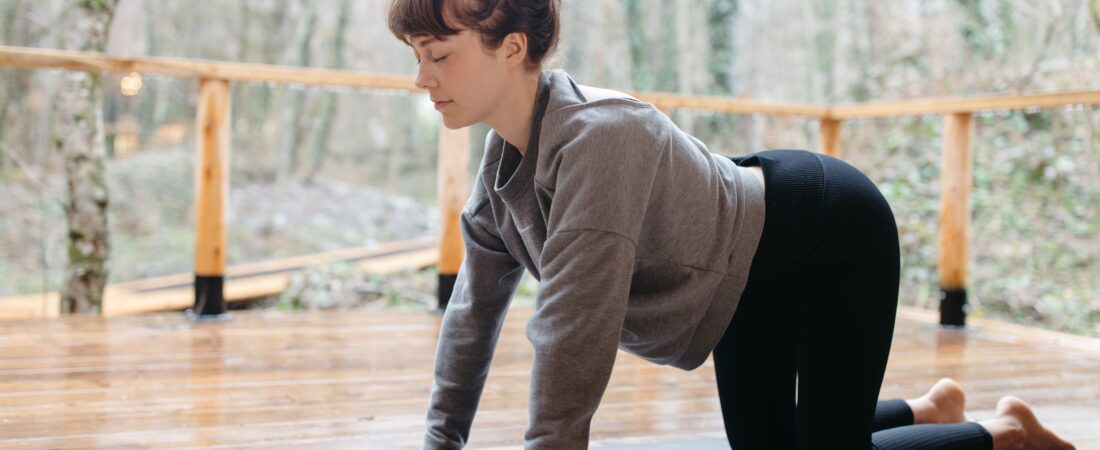
The Cat-Cow is a gentle mobility exercise that encourages movement through the spine.
How to Do It
- Begin on your hands and knees.
- Slowly round your back while gently lowering your head (Cat position).
- Then slowly lift your head and chest while allowing your back to move in the opposite direction (Cow position).
- Continue moving slowly between the two positions.
Perform this movement for about 30 to 60 seconds, using slow and controlled movements.
Why It Can Be Helpful
The Cat-Cow encourages movement throughout the spine and can be a simple way to break up long periods of sitting.
Many people find it useful before starting work, after a long meeting or at the end of the workday.
2. Hip Circles
Long periods of sitting often mean the hips remain in the same position for extended periods.
Hip circles encourage gentle movement around the hip joint.
How to Do It
- Stand comfortably with your feet about shoulder-width apart.
- Place your hands on your hips.
- Slowly rotate your hips in a circular motion.
- Perform several circles in one direction before changing directions.
Move slowly and stay within a comfortable range of motion.
Why It Can Be Helpful
Hip circles encourage movement around the hips and provide a simple way to introduce movement after sitting for long periods.
If your hips often feel stiff after working at a desk, you may also find our article Hip Stretches for People Who Sit All Day helpful.
3. Thoracic Rotation
The thoracic spine refers to the upper and middle portion of your back.
Many office workers spend much of the day looking straight ahead at a computer screen, leaving fewer opportunities for rotational movement.
Thoracic rotations encourage gentle movement through this area.
How to Do It
- Sit or stand comfortably.
- Cross your arms over your chest.
- Slowly rotate your upper body to one side.
- Return to the centre.
- Repeat on the opposite side.
Move slowly without forcing the movement.
Why It Can Be Helpful
This exercise encourages movement through the upper back and can be a useful addition to a work break after prolonged computer use.
Combined with regular walking breaks, it helps introduce more variety into your daily movement routine.
4. World’s Greatest Stretch (Beginner Version)
Despite its name, this exercise doesn’t need to be intimidating.
A modified version is suitable for beginners and combines several movements into one exercise.
How to Do It
- Step one foot forward into a comfortable lunge position.
- Place both hands on the floor or on a sturdy chair if needed.
- Gently rotate your upper body toward your front leg.
- Return to the starting position.
- Repeat on the opposite side.
Use a chair or bench for support if reaching the floor feels uncomfortable.
Why It Can Be Helpful
This movement encourages coordinated movement through the hips, upper back and shoulders.
Rather than trying to stretch as far as possible, focus on slow, controlled movement and staying comfortable throughout the exercise.
5. Supported Deep Squat Hold
The deep squat is a movement many people perform naturally in everyday life, such as picking something up from the floor or gardening. However, after spending years sitting in chairs, some people find this position uncomfortable.
A supported deep squat allows beginners to practise the movement safely while maintaining balance.
How to Do It
- Stand facing a sturdy chair, desk or countertop.
- Hold on lightly for support.
- Slowly lower yourself into a comfortable squat.
- Keep your heels on the floor if possible.
- Hold the position for 10 to 20 seconds before standing up slowly.
If a deep squat feels uncomfortable, don’t force the movement. Simply squat as low as feels comfortable while maintaining good control.
Why It Can Be Helpful
This movement encourages mobility through the hips, knees and ankles while helping your body become more comfortable moving through different positions.
Remember, the goal isn’t to squat as deeply as possible. It’s to move comfortably within your own range of motion.
6. Shoulder Circles
Shoulder circles are one of the simplest mobility exercises and can easily be performed during a work break.
Because many office workers spend long hours typing or using a mouse, this exercise is an easy way to encourage shoulder movement throughout the day.
How to Do It
- Stand or sit comfortably.
- Slowly roll both shoulders forward in a circular motion.
- Complete 10 slow circles.
- Reverse the direction and perform another 10 circles.
Keep the movement slow and controlled rather than rushing through it.
Why It Can Be Helpful
Shoulder circles encourage movement around the shoulder joint and are simple enough to perform almost anywhere.
If your shoulders often feel tight after computer work, you may also enjoy our article Shoulder Stretches for Office Workers: Simple Ways to Relieve Shoulder Stiffness.
7. Ankle Circles
The ankles are often overlooked during mobility routines, despite playing an important role in walking and everyday movement.
Ankle circles are easy to perform and require very little space.
How to Do It
- Sit comfortably in a chair or stand while holding onto a stable surface.
- Lift one foot slightly off the floor.
- Slowly rotate your ankle in a circular motion.
- Complete 10 circles in each direction.
- Repeat with the other foot.
Avoid moving too quickly. Slow, controlled circles are more effective than fast movements.
Why It Can Be Helpful
This exercise encourages movement around the ankle joint and can be a useful addition to your routine, especially if you spend long periods sitting during the day.
A Simple 5-Minute Mobility Routine
If you’re new to mobility exercises, you don’t need a long workout to get started.
Try this simple five-minute routine:
| Exercise | Time |
| Cat-Cow | 30–60 seconds |
| Hip Circles | 30 seconds each direction |
| Thoracic Rotations | 1 minute |
| Supported Deep Squat Hold | 1 minute |
| Shoulder Circles | 1 minute |
| Ankle Circles | 1 minute |
Feel free to adjust the timing based on your comfort and schedule.
Even a few minutes of movement can be a valuable way to break up long periods of sitting.
Common Mistakes
Moving Too Quickly
Mobility exercises are about controlled movement, not speed.
Take your time and focus on smooth, comfortable movements.
Forcing Your Range of Motion
You don’t need to move as far as someone else.
Stay within a comfortable range and allow your mobility to improve gradually over time.
Expecting Immediate Results
Like most healthy habits, mobility improves through consistency.
Small amounts of movement performed regularly are often more beneficial than occasional long sessions.
Only Moving When You Feel Stiff
Many people wait until discomfort appears before moving.
Instead, try building mobility exercises into your routine before stiffness develops.
For example, performing a few movements during a work break can help encourage more movement throughout the day.
Frequently Asked Questions
How often should I do mobility exercises?
Many beginners benefit from performing mobility exercises several times each week. Some people also enjoy incorporating a few movements into their daily routine, especially after long periods of sitting.
Can beginners do mobility exercises?
Absolutely.
Most mobility exercises can be modified to suit different fitness levels. Start with simple movements and gradually build your routine over time.
Do mobility exercises replace stretching?
Not completely.
Mobility exercises and stretching complement each other. Stretching focuses more on muscle flexibility, while mobility exercises combine movement with control.
Do I need any equipment?
No.
Most beginner mobility exercises require only your body weight and a small amount of space.
How long should a mobility routine be?
It doesn’t have to be long.
Even a five-minute routine can be a practical way to introduce more movement into your day.
Conclusion
Mobility exercises are a simple way to encourage more movement throughout the day.
You don’t need to be an athlete or spend hours exercising to benefit. A few minutes of gentle, controlled movement can help break up long periods of sitting and encourage your body to move through different positions.
The key is consistency.
Rather than searching for the perfect routine, focus on building a habit you can maintain. Combining mobility exercises with walking, stretching and regular movement breaks can help create a more active lifestyle that fits into even the busiest schedule.
Remember, your body was designed to move. Small movement habits performed consistently often have the greatest long-term impact.