Introduction
Would you like to build upper body strength but find regular push-ups too difficult? Looking for a beginner-friendly exercise that you can do at home without equipment? Or perhaps you’re unsure where to begin with strength training.
If so, wall push-ups are an excellent place to start.
Many beginners believe they need to perform standard push-ups on the floor immediately. However, starting with a variation that matches your current fitness level is often a more effective way to build strength and confidence.
Wall push-ups reduce the amount of body weight you need to lift, making the movement easier to control while still helping you practise proper pushing technique.
They require no equipment, take very little space and can easily be included in a beginner home workout.
In this article, you’ll learn what wall push-ups are, why they’re beneficial for beginners and how to perform them safely with good technique.
If you’re new to strength training, our article Bodyweight Exercises for Beginners: A Simple Guide to Building Strength Without Equipment introduces several beginner-friendly exercises that require little or no equipment.
What Are Wall Push-Ups?
Wall push-ups are a beginner variation of the traditional push-up.
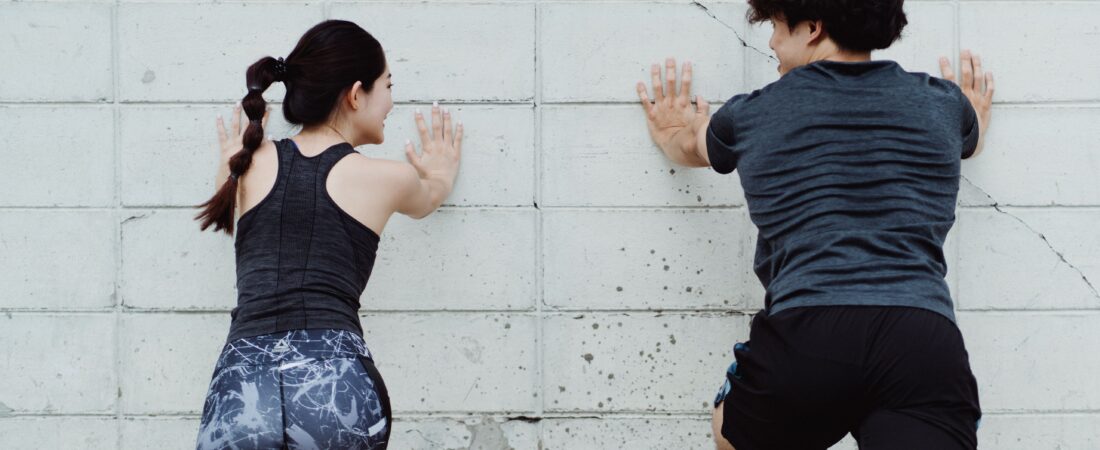
Instead of placing your hands on the floor, you perform the exercise while standing and pushing against a wall.
Because your body remains more upright, less of your body weight is supported by your arms. This makes the exercise easier than a standard floor push-up while still allowing you to strengthen many of the same muscles.
As your strength improves, wall push-ups can serve as a stepping stone toward more challenging push-up variations.
For many beginners, they provide an excellent opportunity to learn proper movement patterns before progressing further.
Benefits of Wall Push-Ups
1. Beginner-Friendly
Wall push-ups are one of the most accessible upper-body exercises for beginners.
Because the wall supports much of your body weight, the movement feels more manageable than a traditional push-up.
This allows beginners to focus on learning proper technique without feeling overwhelmed.
2. Strengthen Your Upper Body
Although wall push-ups are easier than floor push-ups, they still help strengthen several muscles involved in pushing movements.
Regular practice can help beginners gradually develop the strength needed for more challenging exercises in the future.
3. Require No Equipment
One of the biggest advantages of wall push-ups is their simplicity.
All you need is:
- A sturdy wall.
- Comfortable footwear (optional).
- Enough space to stand safely.
This makes wall push-ups an ideal exercise for people exercising at home, at work or while travelling.
4. Help Build Confidence
Many people feel discouraged if they cannot perform a standard push-up.
Wall push-ups provide a practical alternative that allows beginners to experience success while continuing to improve.
Remember, choosing an easier variation isn’t a sign of weakness—it’s a smart way to build strength progressively.
5. Easy to Progress
As your upper-body strength improves, you can gradually make wall push-ups more challenging.
For example, you may:
- Stand farther away from the wall.
- Perform more repetitions.
- Progress to push-ups using a bench or countertop.
- Eventually work toward floor push-ups.
Building strength gradually often leads to better long-term progress than attempting exercises that are currently too difficult.
Muscles Worked During Wall Push-Ups
Wall push-ups involve several muscles working together to control the movement.
These include muscles in your:
- Chest.
- Shoulders.
- Upper arms.
- Core.
While the exercise primarily strengthens the upper body, your core also helps stabilise your body throughout the movement.
This coordination makes wall push-ups an effective beginner exercise for developing overall movement control.
How to Do a Wall Push-Up
Follow these simple steps to perform a wall push-up safely.
Step 1: Stand Facing a Wall
Stand facing a sturdy wall with your feet approximately shoulder-width apart.
Position yourself about an arm’s length away from the wall.
Your distance from the wall can be adjusted later depending on your comfort and strength.
Step 2: Place Your Hands on the Wall
Place both hands flat against the wall at approximately shoulder height and slightly wider than shoulder-width apart.
Spread your fingers comfortably and keep your wrists in a natural position.
Relax your shoulders and keep your head facing forward.
Step 3: Keep Your Body in a Straight Line
Step your feet back slightly until your body forms a straight line from your head to your heels.
Avoid bending at your hips or arching your lower back.
Gently tighten your stomach muscles to help maintain good posture throughout the exercise.
Step 4: Slowly Bend Your Elbows
Slowly bend your elbows and allow your body to move toward the wall.
Keep the movement controlled and avoid rushing.
Aim to keep your body moving as one unit rather than allowing your hips or shoulders to move separately.
Step 5: Push Back to the Starting Position
Once you are comfortably close to the wall, press through your hands and slowly straighten your elbows to return to the starting position.
Keep the movement smooth and controlled.
Avoid pushing away from the wall too quickly or locking your elbows forcefully at the end of the movement.
Continue breathing naturally throughout the exercise.
Common Mistakes
Standing Too Close to the Wall
If you stand very close to the wall, the exercise becomes much easier and provides less challenge.
Try standing about an arm’s length away to begin. As your strength improves, you can gradually move your feet farther back.
Letting Your Hips Sag
Some beginners allow their hips to drop as they move towards the wall.
Instead, keep your body in a straight line from your head to your heels throughout the movement.
Engaging your core muscles can help maintain good posture.
Flaring Your Elbows Too Much
Allowing your elbows to point directly out to the sides may make the movement feel less comfortable for some people.
Instead, keep your elbows at a comfortable angle rather than pushing them excessively outward.
Rushing the Movement
Wall push-ups should be performed with control.
Moving slowly allows you to focus on proper technique while helping you develop strength more effectively.
Holding Your Breath
Many beginners unintentionally hold their breath during strength exercises.
Instead, breathe naturally throughout the movement.
For example, breathe in as you move towards the wall and breathe out as you push away.
Easier and Harder Variations
One advantage of wall push-ups is that they can be adjusted as your strength improves.
Easier Variation
If wall push-ups still feel challenging, stand slightly closer to the wall.
This reduces the amount of body weight your arms need to support.
You can also perform fewer repetitions while focusing on good technique.
Harder Variation
As you become stronger, increase the challenge by moving your feet farther away from the wall.
You may also progress to:
- Countertop push-ups.
- Bench push-ups.
- Knee push-ups.
- Standard floor push-ups.
The goal isn’t to progress quickly.
It’s to progress when you can comfortably perform the current variation with good technique.
How Often Should Beginners Do Wall Push-Ups?
For many beginners, including wall push-ups in a strength routine two to three times per week is a sensible starting point.
Focus on learning the movement rather than completing a large number of repetitions.
As your confidence improves, you can gradually increase the repetitions or progress to more challenging variations.
Remember, building strength is a gradual process.
Consistent practice is often more beneficial than trying to do too much in a single session.
If you’re working on building sustainable exercise habits, our article How to Make Healthy Habits Last: 10 Simple Strategies That Work offers practical advice for staying consistent.
Frequently Asked Questions
Are wall push-ups good for beginners?
Yes.
Wall push-ups are one of the most beginner-friendly upper-body exercises because they reduce the amount of body weight you need to lift while allowing you to practise proper push-up technique.
Can wall push-ups help me prepare for regular push-ups?
Yes.
Wall push-ups are commonly used as an easier progression before moving on to countertop push-ups, knee push-ups and eventually standard push-ups.
How many wall push-ups should beginners do?
Start with a comfortable number of repetitions while maintaining good technique.
As your strength improves, you can gradually increase the number of repetitions or move to a more challenging variation.
Can I do wall push-ups every day?
Some people include wall push-ups in their daily movement routine, while others perform them as part of a strength programme several times each week.
Choose a routine that allows you to recover comfortably while remaining consistent.
Do I need any equipment?
No.
Wall push-ups require only a sturdy wall, making them one of the simplest strength exercises to perform at home or at work.
Conclusion
Wall push-ups are an excellent exercise for beginners who want to build upper-body strength without feeling intimidated by traditional floor push-ups.
They require no equipment, can be performed almost anywhere and provide a safe way to learn proper pushing technique.
Remember, progress doesn’t happen overnight.
Focus on good technique, move with control and practise consistently.
As your strength improves, you can gradually progress to more challenging push-up variations.
To continue building your strength, explore our guides on Bodyweight Squats for Beginners, Glute Bridges for Beginners and Lunges for Beginners to develop a balanced beginner strength routine.